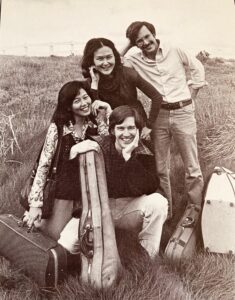

The Sequoia String Quartet was a renowned American string quartet active from 1972 to 1985.
Since its founding in 1972, the Sequoia String Quartet has established itself as one of America’s important chamber ensembles. Quartet-in-Residence at California Institute of the Arts, the Sequoia gained national prominence in 1976 by winning the prestigious Walter W. Naumburg Chamber Music Award. The group has been awarded a 1979-80 touring and residence grant from the National Endowment For the Arts, and a grant from the Martha Baird Rockefeller Fund to commission a new work by composer Paul Chihara, “Concerto for String Quartet and Orchestra. Seiji Ozawa will conduct the world premiere of this work with the Sequoia Quartet as soloist in Osaka in Septem- ber, 1980, during the Sequoians’ first tour of Japan and the Far East. The Sequoia Quartet has more than earned the San Francisco Chronicle’s observation: “Clearly, this is a major ensemble!”
Yoko Matsuda, violinist, studied at the Toho School of Music in Japan and came to the United States in 1960. She has appeared with the Chamber Music Society of Lincoln Center and Music from Marlboro. Miwako Watanabe, violinist, came to the United States in 1958 to study with Ivan Galamian at the Curtis Institute of Music. She has been a member of the Munich Bach Orchestra under the direction of Karl Richter. James Dunham, violist, is a graduate of the California Institute of the Arts. He has toured with Music from Marlboro and is principal violist of the California Chamber Symphony. Robert Martin, cellist, is a graduate of the Curtis Institute of Music, where he studied with Leonard Rose and Orlando Cole. He has participated in the Marlboro Festival and master classes with Pablo Casals. The Sequoians’ individual careers intersected for years before the founding of the quartet. Yoko Matsuda and Miwako Watanabe were classmates in Tokyo; Watanabe and Robert Martin studied together at the Curtis Institute in Philadelphia; Martin and Matsuda coached together in chamber music at Yale University; Matsuda and James Dunham worked together in the unique musical environment of the founding of the California Institute of the Arts. years
“Here is a group with so many excellences that one wonders what to admire first. Perhaps the most exciting element of the playing was a willingness to take risks and, since technique and imagination matched daring, the risks paid off.” LOS ANGELES HERALD-EXAMINER
“Bartok emerged triumphant, for the Sequoians are ideal interpreters of his music, singing with voluptuous tonal allure in the lyric flights, stinging like vipers when his muse is agitated. It was an evening of exciting music making.’
LOS ANGELES TIMES
“Their playing is finely aware of all those rhythmic and harmonic nuances that delight the mind and pierce the heart in music, and the pleasure comes not merely from the quickness and precision of their response, but as much from its simplicity and subtlety. Indeed, the Sequoia’s quartetmanship is in all respects admirable: the tone, pleasingly varied but with a lean, centered sort of sound as point of departure is transparent and balanced. Intonation and rhythmic definitions are impeccable, and the players obviously listen to each other with delight as well as attention.”
THE BOSTON GLOBE
“There were moments of seething intensity in the Sequoia’s performance coupled with careful attention to shifting colors and textures as lean sonorities gathered into dense webs and then SAN FRANCISCO CHRONICLE unraveled into other shapes.”
Their Ravel & Bartok quartet session on Delos label is staff favorite.